He Stepped Out with the Trash, And Never Came Back
Narrative of War from Within
Azadeh Sadeghi*
Translated by Raha Sabet Sarvestany
IRWomen**
I am writing this while six days have passed since the war began, and my family and I have officially become displaced by it.
On Monday, around 9:30 in the morning, I was lying next to my mother on her bed when suddenly a massive explosion and the violent shaking of the windows jolted us awake. We ran toward the living room, held each other tightly in fear, and screamed:
“War has started! War has started! Azam! Dad! It’s war…”
Neighbors rushed out in panic, and the sound of screams filled the building.
For hours afterward, my knees kept shaking. It felt as if I had been emptied from within. I had never experienced fear so raw, so naked, so close. I had never been this afraid in my life. This was my first encounter with war.
Each of us wandered anxiously in a corner of the house, checking the news and making calls, one after another:
“Has war really started?”
“Where did they hit?”
“Are you okay?”
“Do you have any news from others?”
“What’s going to happen now?”
My mother, out of sheer anxiety, began cleaning the windows and cooking. My father’s blood pressure went up, and he lay down for a while. Azam and I were desperately searching for news, but our ears were sharpened to every sound. From that moment until now, every noise makes us jump a meter into the air.
A few hours passed, and everything seemed calm. For a moment, I even thought that maybe what had happened in the morning was just a nightmare, that it was over. But my mother said:
“This is the calm before the storm, my dear. Get some sleep, because tonight we won’t be able to sleep with the explosions and fear. It was like this during the twelve-day war too.”
She was right.
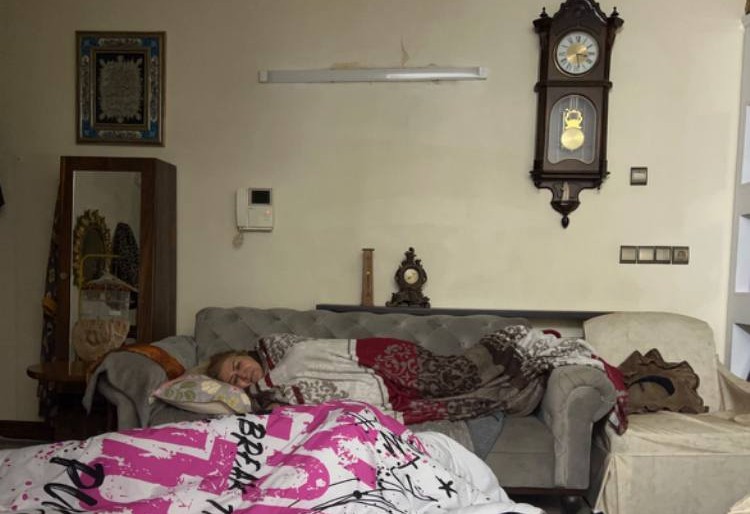
From around eight or nine in the evening, the explosions started again nonstop. We were trapped in a terrifying anxiety, as if at any moment something catastrophic would happen and we would have to take shelter somewhere in the house. That night, we laid our mattresses next to each other in the living room, but none of us closed our eyes.
The next day, we had officially entered the second day of war. We only had access to the national internet; satellite signals were completely cut off. This lack of information was suffocating us.
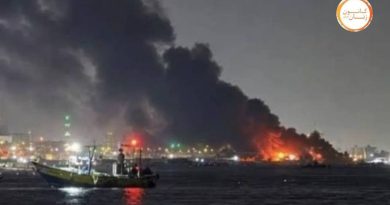
Around eight in the evening, we were sitting together, drinking tea with dates, trying to analyze the situation, when suddenly two explosions, very close to our home, shook everything. The whole house trembled as if it was about to collapse.
We screamed and immediately rushed to take shelter. My father fell to the ground, and we cried out:
“Dad! Dad! Come here…!”
Again, explosions. Again, the shaking of the house, windows, chandelier, everything.
Missiles.
I don’t know how many minutes it lasted, but for us, every second felt like hours. It wouldn’t end…
Boom.
The whole structure of the house is shaking. The sound of breaking glass.
Boom.
Screams from the building. A child crying.
Boom.
Me: “God, please protect us…”
Mom: “Recite the ‘Azem al-Bala’ prayer…”
Me: “I don’t remember… I’m scared…”
Azam: “Azzi, calm down!”
Mom held me: “My dear, whatever happens, we are together…”
Then, suddenly, silence.
Now there were different sounds, the neighbors rushing out, hurried footsteps, panic, anxiety… and then the sound of an ambulance.
Some people had gone to the end of the street to help a neighbor, he had stepped out, as he did every night, to take out his trash. But now his lifeless body lay on the ground, the garbage scattered beside him.
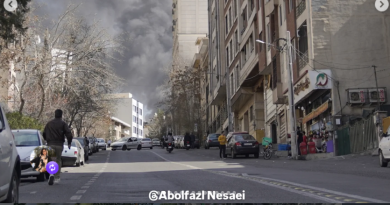
We learned that several missiles had hit two streets away from us, and a fragment had taken his life.
The smell of gunpowder filled the entire apartment complex. The courtyard was covered in dust. All the windows on the western side of the building were shattered, including my mother’s room. The only luck we had was that her door had been closed, so the glass had not been thrown toward us.
…
A few minutes passed. We were still in shock.
Who could have imagined that missiles would land just steps away from our home?
Wasn’t death supposed to be for someone else, for the neighbor, not us?
Hadn’t they said the missiles would be precise, clean, silent?
So where exactly was the “target”?
Was our home part of that target?
And the neighbor who lost his life to a fragment,
which “precision strike” was he meant to be part of?
My mother’s blood sugar had spiked, and my father’s face had turned red. Still, he kept saying,
“No, my blood pressure isn’t high, I’m fine. They won’t hit here again. I just fell a little, my leg just hurts.”
My aunt, Batool, called in a panic:
“We read in the news that your area was hit, are you okay?”
I said, “It was terrifying, Aunt… I really thought it was over, that we were all going to die,” and I broke down in tears.
She replied, “Oh my dear… come here. Come to Isfahan, to our home. It’s better if we’re together. They’re hitting here too, but at least where we live, it’s quieter. At least the house hasn’t shaken since yesterday.”
After the intense explosions near our home, we set out on the road as quickly as we could. We were afraid of the road too afraid that if we were out there, a missile might strike. But our neighborhood was no longer a place we could stay. We had to choose remain in a home that was no longer truly safe or take the road toward an uncertain fate.
Around eight in the morning, we arrived at my aunts Batool and Zahra’s home in southern Isfahan. I hadn’t seen them for six years. I hugged Aunt Batool and said,
“Thank you for giving us, war-displaced people, a place to stay.”
She said, “What are you saying, my dear? History has repeated itself; we were war-displaced too.”
She was right. They were among the last people to leave Abadan when Iraq was bombing the city. They fled in such haste that they even left behind their identification documents. And now, more than thirty years later, history was repeating itself for their nieces and nephews.
Their home is small but warm, with two bedrooms. In these past days, we have tried to be kinder to one another. Aunt Batool does most of the cooking, and the rest of us help with cleaning, washing dishes, and other chores.
But Aunt Zahra still goes to her shop every morning until noon. She is a well-known stationery seller in the neighborhood, loved for her kindness and the way she treats her customers. But these days, she has no energy, no spirit. The shop owner told her,
“Ms. Sadeghi, whenever you feel afraid, or if you hear an explosion nearby, just close the door and run home.”
So, she sits at the back of the shop, as she says, “on standby.” But until she returns home, our hearts leave our bodies a thousand times. Even though the shop is only a few streets away, these days the sound of bombs and explosions can be heard all across Isfahan.
Yesterday, for the first time, I heard the sound of American fighter jets. It was 6 a.m. We had had a few hours of calm, and I was just drifting back to sleep when a massive explosion threw us out of bed. Our hearts dropped, just like the night they hit two streets away from our home in Tehran.
I had thought I would never have to relieve that kind of fear again. But no, it feels like wherever we go, it follows us.
The jet stayed in the sky for nearly ten minutes, circling, it seemed, right above our heads. My knees started shaking again; I felt hollowed out from the inside.
“My knees are shaking… I’m so scared,” I said.
Aunt Batool replied, “No, my dear, my knees are shaking too. It’s natural…”
That comforted me.
During those ten minutes, which felt like an hour, I kept thinking:
“What if it hits our house? What if it hits the house next door and the blast wave takes us too?”
Then I would feel ashamed of myself, so where should it hit instead?
But still, the thought returned: wherever it hits, who knows what the explosion will do to the surrounding homes…
Last night, Mehdi, one of our neighbors, called my father and said that ever since we left our apartment complex, our neighborhood has been under missile attack every single night. Each night was worse than the one before.
And every time I think of my father’s words on that terrifying night:
“They don’t hit the same place twice.”
But they did.
The night before last, I don’t know if it was one missile or several bombs, but they struck right in the alley next to our home in Tehran. One of the neighbors’ cars was hit by shrapnel and completely crashed. The windows of all the houses for several streets around including ours were shattered. Even the apartment building itself has been damaged by the force of the explosions.
Mehdi said when you walk down the street leading to our home now, it feels like walking through ruins, everywhere covered in broken glass, debris, dust from the blasts. As if it no longer resembles our beautiful street at all.
He said most of the residents have evacuated, but three or four families are still in our building, they have nowhere else to go.
My heart aches for Mrs. Mansourian, one of our neighbors, who has to care for her disabled mother-in-law. She has stayed there all this time because she has no choice. We called her, and my mother pleaded with her:
“Please come to Isfahan, to our relatives’ home. There’s space, don’t worry. At least we can be together…”
I don’t know how those few neighbors have survived the constant shaking, the sounds, the fear of explosions at any moment. Even imagining it crushes my spirit.
I hope Mrs. Mansourian somehow manages to bring her mother-in-law and come here or go anywhere safer. But then I find myself asking: where, exactly?
We are in another city, yet we are experiencing almost the same thing.
Where is safe, really?
Is there any safe place left?
The night we left our home, I thought we would return very soon. I wanted, from the bottom of my heart, for my father’s words to come true, that they wouldn’t strike the same place twice.
I never imagined that what would be waiting for us to return to…
would be a half-destroyed home.
*Animator and documentary filmmaker
**Iranian Women’s Center